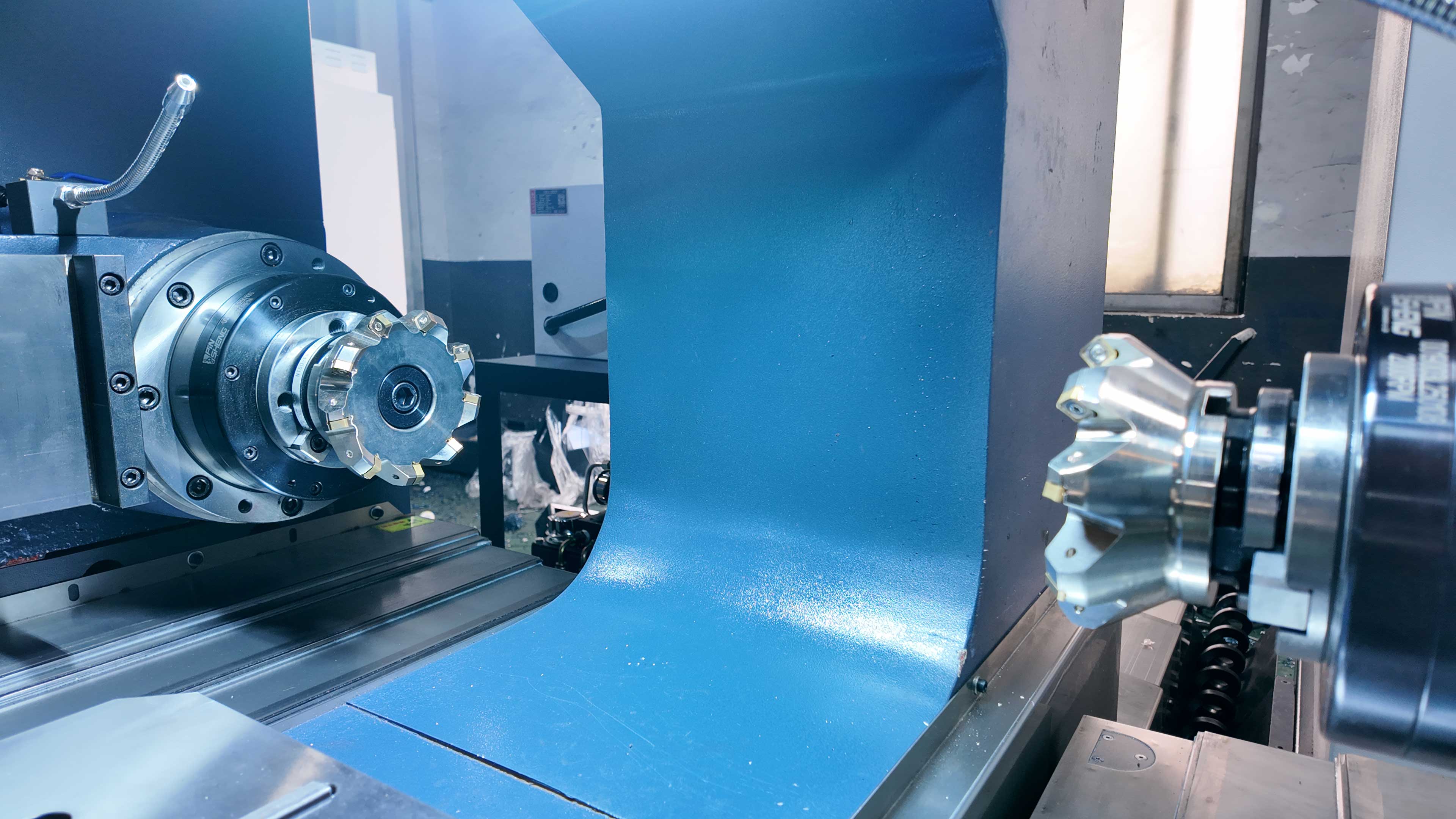
CNC Milling Machine: The Intelligent Core of Precision Manufacturing

In the grand symphony of modern manufacturing, the CNC milling machine stands as an indisputable core instrument, renowned for its precision, efficiency, and intelligent capabilities. It represents not only a revolutionary evolution from traditional milling processes but also a powerful engine driving the magnificent transformation of "Made in China" into "Intelligent Manufacturing in China."
I. Evolution: The Leap from Manual to CNC
Traditional milling machines heavily relied on the operator's experience and manual dexterity, facing inherent limitations in machining accuracy and efficiency. The infusion of Computer Numerical Control (CNC) technology endowed the machine with a "brain" and "nerves." Operators simply need to compile the geometric shapes and process parameters of the workpiece into G-code or M-code instructions and input them into the control system. The machine can then automatically and precisely execute complex cutting tasks. This "program-driven" model completely liberates human intervention from direct control over machining accuracy, achieving a qualitative leap from "experience-driven" to "program-driven." Today, high-end CNC milling machines commonly achieve positioning accuracy at the micron level (within 0.01 mm), with astonishing repeatability, providing a solid foundation for precision manufacturing.
II. The Intelligent Core: A Symphony of Advanced Technologies
A modern CNC milling machine is a symphony orchestrated by multiple cutting-edge technologies:
The Brain: CNC System: Systems like FANUC, SIEMENS, domestic Huazhong CNC (HNC), or Guangzhou CNC (GSK) interpret machining programs and command the entire operation.
Senses & Nerves: Servo Drives & Position Feedback: High-response servo motors paired with precision encoders or linear scales form closed-loop control, ensuring faithful reproduction of motion trajectories.
The Framework: Precision Mechanical Structure: A rigid bed, hardened guideways, and pre-tensioned ball screws work together to create a stable platform, resisting cutting vibrations.
The Cutting Edge: Automatic Tool Changer (ATC): Tool magazines holding dozens or even hundreds of tools, coupled with lightning-fast tool change times (e.g., 1-2 seconds), drastically reduce non-cutting time.
Expanded Capabilities: Multi-Axis Machining: While three axes (X/Y/Z) are standard, four-axis (adding a rotary A-axis) and increasingly widespread five-axis (adding tilting/swiveling B/C axes) technologies enable the machining of complex freeform surfaces (e.g., impellers, aerospace components) in a single setup, significantly boosting efficiency.
III. Empowering Industries: The Ubiquitous Shaper of Precision
CNC milling machines, with their irreplaceable flexibility, are deeply integrated into the fabric of modern industry:
Mold & Die Making: Machining cavities for precision injection molds, die-casting molds, and stamping dies, where surface accuracy is critical for product consistency.
Aerospace: High-efficiency, precision milling of high-strength titanium alloy and superalloy structural components, such as aircraft spars and engine parts.
Precision Machinery & Instrumentation: Batch production of key components like gearbox housings, pump/valve bodies, and bases for precision measuring instruments.
Electronics & Communications: Micro-machining of 5G base station filter cavities, precision parts for semiconductor equipment, and molds for high-end connectors.
Medical Devices: Custom machining of implants (e.g., artificial joints), complex surgical instruments, and dental components from high-biocompatibility materials.
Automotive Manufacturing: High-efficiency machining of engine blocks/cylinder heads, transmission housings, and new energy vehicle battery enclosures and motor housings.
IV. The Future is Now: Trends in Intelligence and Integration
CNC milling technology is advancing towards higher dimensions:
Smart Factory Node: Deep integration into the Industrial Internet of Things (IIoT) enables remote monitoring, data acquisition (OEE analysis), and predictive maintenance, enhancing overall equipment effectiveness.
AI Empowerment: Adaptive control optimizes parameters in real-time based on cutting loads; machine learning diagnoses tool wear and predicts lifespan; intelligent programming simplifies complex process setup.
Rise of Machining Centers: Integration of milling with turning (mill-turn), additive manufacturing (3D printing), laser processing, and other functions into single machines enables "complete part machining" in one setup.
Green & Efficient: Widespread adoption of advanced tool coatings, Minimum Quantity Lubrication (MQL), and High-Performance Cutting (HPC) / High-Speed Cutting (HSC) strategies reduces energy consumption and resource usage.
The CNC milling machine, this code-driven precision dancer, continuously reshapes the boundaries of modern industrial manufacturing with its tireless accuracy and ever-expanding creativity. From microscopic electronic components to massive aircraft structures, its "intelligent cutting edge" is omnipresent. It is more than just cold steel; it is a core witness and driver of manufacturing's intelligent evolution – continuously inscribing the marks of precision, efficiency, and innovation onto human material civilization through the perfect fusion of digital and mechanical realms. The new vitality of this mother machine in the digital age powerfully supports the ascent of manufacturing, both in China and globally, towards ever-greater heights.
In the mold steel processing industry, how to improve the efficiency of mould milling is always a major issue.
CNC Milling Machine: The Intelligent Core of Precision Manufacturing
Related Article